C2C Blanket Size Chart & Yarn Yardage Guide (With Worked Examples)
Measure a 4×4 C2C swatch, convert blanket size into tiles, and estimate how many skeins you need using worked metric and imperial examples.
StitchSnapLast updated
Multiply your chart width and height by the matching dimensions of one measured C2C tile. For a 45 × 56 tile chart, there are 100 diagonal rows and 2,520 tiles. To estimate yarn, multiply 2,520 by the length per tile from your sample, add a reserve, and round up by skein length. Leave room for a border in both the size and yarn estimates.
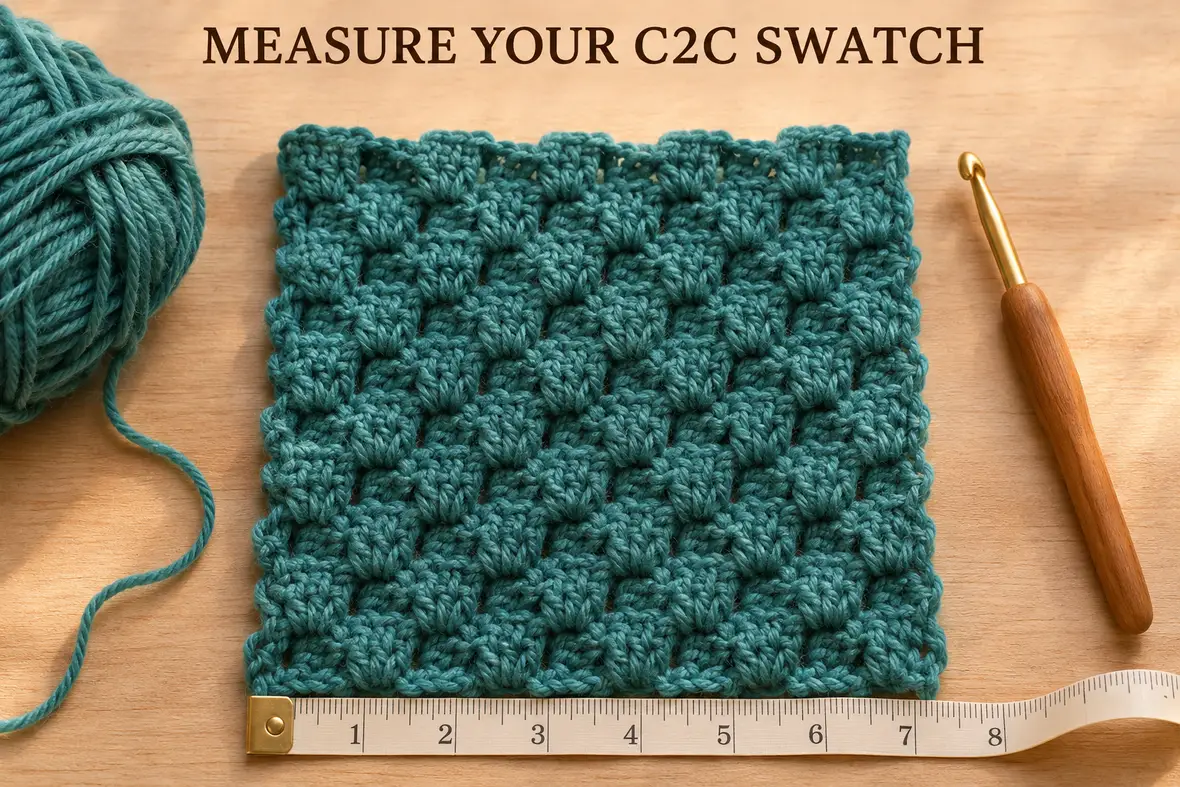
Measure a 4×4 C2C swatch
- Use the yarn, hook and tile construction planned for the blanket. A chain-3 tile and a tighter alternative can give different fabric dimensions.
- Crochet a square four tiles across and four tiles tall. Count tiles horizontally and vertically along the edges. The swatch itself has seven diagonal rows.
- Finish the swatch as you intend to finish the blanket. Lay it flat without stretching. Measure width and height separately because the tiles can be rectangular.
- Divide each measurement by four. Write down the tile width, tile height and hook size together so you can repeat the gauge.
- Measure the yarn used by the sample. You can unravel it and measure the length, or weigh the swatch with a sensitive scale and use the yarn label’s length-to-weight ratio. A 10 g sample from a 100 g skein labeled 200 m used roughly 20 m, assuming the same fiber and no added notions.
If you measure in centimeters, keep the size calculation in centimeters. Keep yarn inputs together in meters or together in yards. The exact conversion is 1 in = 2.54 cm and 1 yd = 0.9144 m.
Why ordinary single-crochet gauge gives a different result
A horizontal graph usually assigns one chart cell to one stitch, with a separate row gauge. A C2C chart assigns one cell to a whole tile built from multiple stitches. Counting 20 single crochet stitches per 10 cm tells you how wide 20 of those stitches are. It gives no measurement for 20 C2C tiles. Make a new swatch when switching construction. C2C, graphghan and tapestry guide
C2C blanket size chart
This table uses a square 1 in tile and a 4 × 4 sample that consumes 8 yd. All yardage includes 10% reserve and is rounded upward to the displayed whole yard or meter. Sizes are planning targets for the main panel. A border and fit for a specific mattress can shift your target.
| Blanket | Finished target | Tiles at 1 in per tile | Yarn with reserve |
|---|---|---|---|
| Baby | 30 × 36 in · 76 × 91 cm | 30 × 36 | 594 yd · 544 m |
| Stroller | 30 × 40 in · 76 × 102 cm | 30 × 40 | 660 yd · 604 m |
| Lapghan | 36 × 48 in · 91 × 122 cm | 36 × 48 | 951 yd · 870 m |
| Throw | 50 × 60 in · 127 × 152 cm | 50 × 60 | 1,650 yd · 1,509 m |
| Twin | 66 × 90 in · 168 × 229 cm | 66 × 90 | 3,267 yd · 2,988 m |
| Queen | 90 × 100 in · 229 × 254 cm | 90 × 100 | 4,950 yd · 4,527 m |
| King | 108 × 100 in · 274 × 254 cm | 108 × 100 | 5,940 yd · 5,432 m |
Work backward from the target dimensions
Subtract twice the planned border width from each finished dimension. Divide the remaining width by the measured tile width and the remaining height by the measured tile height. For a 120 × 150 cm throw with a 2 cm border and tiles measuring 2.5 × 2.4 cm, the field target is 116 × 146 cm. The nearest whole-tile chart is 46 × 61, yielding a finished estimate of 119 × 150.4 cm with the border. Round upward when a minimum finished size matters.
Worked example for 45 × 56 tiles
A 4 × 4 swatch measuring 4 × 3.6 in gives tiles 1 × 0.9 in. The panel measures 45 × 50.4 in, or about 114.3 × 128.0 cm. The diagonal count is 45 + 56 − 1 = 100. The 45 × 56 panel has 2,520 tiles, irrespective of the diagonal count.
If 16 tiles use 8 yd, one tile uses 0.5 yd. The field uses about 1,260 yd. Adding 10% brings the total to 1,386 yd, about 1,267.4 m. At 250 yd per skein, that is six skeins in aggregate. If a background takes 75% of the tiles and a motif takes 25%, those estimates round to five background skeins and two motif skeins. Use actual color counts for the shopping list.
Plan bobbins around separate areas of color
One bobbin per color is a starting point. A single diagonal can use the same color in two separate areas, so inspect a wide middle row and count the separate runs that need their own working strand. Reserve can cover some tails and joins. Estimate the border from a separate border sample when it adds several rows or uses a different stitch.
Calculate a blanket from your swatch · Generate a C2C chart
FAQ
How many diagonal rows are in a rectangular C2C blanket?
Add the tile count across and the tile count down, then subtract one. A 45 × 56 chart has 100 diagonal rows. Multiply width by height to count the total tiles.
Where should I measure a swatch that curls?
Lay it flat and measure across the middle in both directions after washing or blocking it the way you will finish the blanket. Make a larger sample if the edges still dominate the measurement.
Do I need to buy the same yarn dye lot?
For adjacent areas of one shade, buy the estimated quantity together and check the dye lot on each label. Reserve can help if that batch becomes hard to find.
How can I check whether the same design will cost less yarn at a smaller size?
Repeat the calculation with the new tile count. A 40 × 50 chart has 2,000 tiles, roughly 79% of 2,520. The proportional estimate assumes the same tile, yarn and stitch. Compare photo chart tools
After sizing your blanket, follow the StitchSnap guide to carry your dimensions into a pattern and compare PDF options.